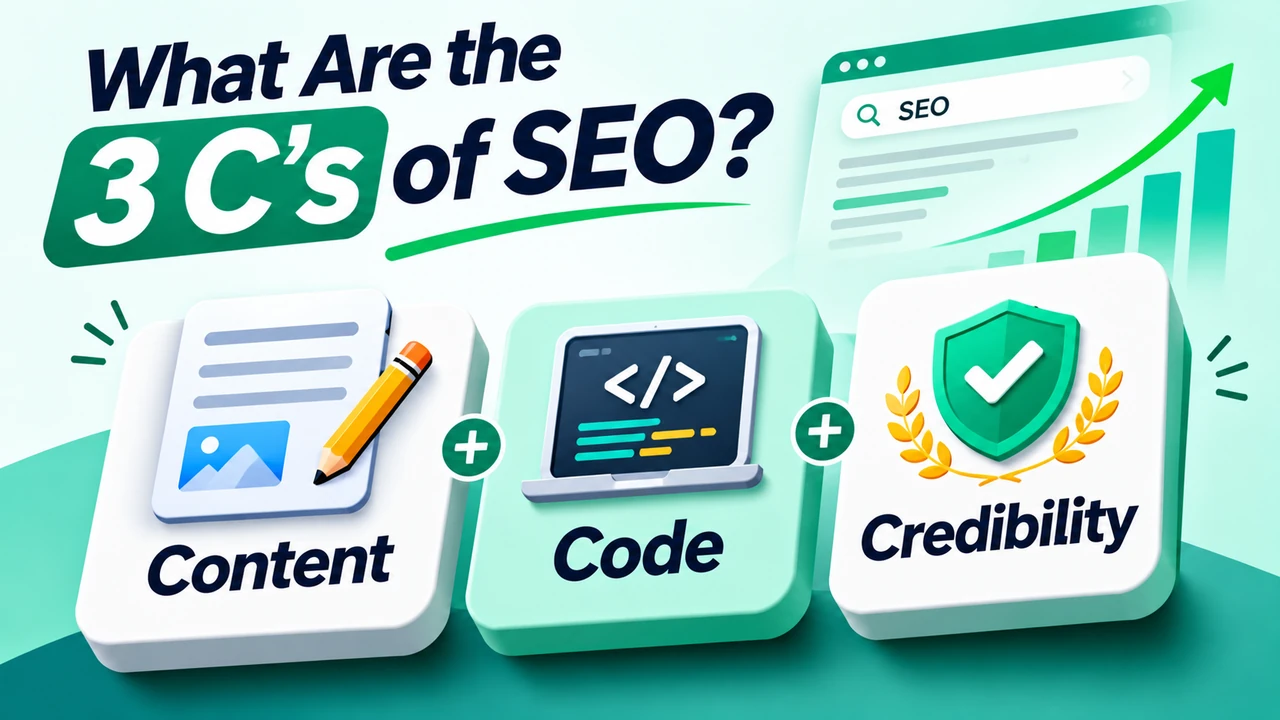
Most founders I meet have been told that SEO is complicated. They hear about algorithms, backlinks, schema and Core Web Vitals, and they cannot tell whether their website or their agency is doing the right things. The numbers show how often the basics fail. Ahrefs found that 96.55% of pages get zero traffic from Google, only 33% of websites pass Core Web Vitals, and among roughly 20 million pages with no backlinks, only about 1 in every 6,671 gets more than 1,000 monthly search visits. The 3 C’s of SEO are content, code and credibility. Content answers what people search for, code lets search engines access and understand your pages, and credibility proves your business deserves to rank. For a founder, the framework turns SEO into three simple questions: Do we answer buyers’ searches well? Can Google read our site? Do others trust us?
TLDR
The 3 C’s of SEO, a framework popularised by Kent Lewis of Anvil Media, break SEO into content, code and credibility. Content means pages that match what your customers search for, especially commercial pages, with real experience and clear answers. Code means the technical foundation: crawlable, indexable, fast, mobile-friendly pages with clean redirects, canonicals and structured data. Credibility means trust signals: relevant backlinks, brand mentions, reviews, author expertise and consistent business information. The three depend on each other, and your weakest C limits your results. In 2026-27 the same three C’s decide whether AI Overviews and chatbots cite your brand. Many practitioners add a fourth C, conversion, which matters most to founders because it turns visitors into revenue.
What are the 3 C’s of SEO?
The 3 C’s are a simple framework that groups everything in SEO into three areas. Kent Lewis of Anvil Media described SEO’s building blocks as content, code and credibility, and the model has stayed popular because it maps neatly to how search engines evaluate websites.
| C | Question it answers | What it covers |
|---|---|---|
| Content | Does your page answer what people search for? | Keywords, search intent, page structure, expertise, freshness |
| Code | Can search engines access and understand your pages? | Crawling, indexing, speed, mobile, redirects, canonicals, schema |
| Credibility | Why should Google trust you over competitors? | Backlinks, brand mentions, reviews, E-E-A-T, business details |
In short: The 3 C’s of SEO are content, code and credibility. Content answers searchers’ needs, code lets search engines access and understand pages, and credibility proves the business deserves to rank.
What does “content” mean in SEO for a founder?
Content is everything on your website that answers a searcher’s need: service pages, product pages, pricing, comparisons, guides, FAQs, images and videos. For a founder, the most valuable content is not the blog. It is the set of pages a ready-to-buy customer lands on.
Match search intent
Search your main keyword and look at what ranks. If Google shows service pages, a blog post will not rank. If it shows guides, a sales page will struggle. Intent decides format.
Prioritise commercial pages
Build strong pages for each service, product, location and use case before writing general articles. These pages bring leads.
Add what AI cannot copy
Ahrefs found that 86.5% of top-ranking pages contain some AI-generated content, but fully AI-written pages make up only 4.6% of top-20 results and rarely rank first. Your pricing logic, customer stories, process photos and founder insights give your content an edge.
Founder content checklist
| Check | Good sign |
|---|---|
| One clear page per service or product | Yes, each with its own URL |
| Title tags include the main search term | Yes, under about 60 characters |
| Direct answers near the top of each section | Yes |
| Real examples, numbers or case studies | Yes |
| Pages updated in the last 12 months | Yes |
In short: Content in SEO means pages that match search intent, with commercial pages built first and real experience added on top. AI-assisted content can rank, but pages written entirely by AI rarely reach the top position.
What does “code” mean in SEO?
Code is the technical foundation that lets search engines find, crawl, render and understand your pages. You do not need to write code as a founder, but you need to know when your website has technical problems, because they quietly block everything else.
How common technical problems are
| Technical issue | How common it is | Business impact |
|---|---|---|
| Redirect (3XX) issues | 95.2% of sites | Wasted crawling and diluted ranking signals |
| Slow pages | 72.3% of sites | Lower rankings and fewer conversions |
| Failing Core Web Vitals | 67% of sites do not pass | Weaker page experience |
| Hreflang errors on multi-country sites | Over 67% of domains using it | Wrong country version ranks |
| HTTP to HTTPS redirect issues | 88% of sites | Duplicate versions and trust warnings |
What a founder should check
- Your important pages appear as indexed in Google Search Console.
- Robots.txt does not block key sections.
- Each page has one clear canonical URL.
- Pages load quickly on mobile.
- Structured data such as Organization, LocalBusiness, Product or FAQ schema is in place.
Use my free robots.txt checker, schema markup generator and SERP preview tool for quick checks.
When the problems go beyond quick checks, such as JavaScript rendering, crawl waste or large-scale redirects, it is usually faster to bring in a technical SEO expert than to learn it all mid-crisis.
In short: Code in SEO is the technical foundation that lets search engines crawl, index and understand a site. Technical problems are extremely common, with 95.2% of sites showing redirect issues and only 33% passing Core Web Vitals, so founders should check indexing, robots.txt, canonicals, speed and schema.
What does “credibility” mean in SEO?
Credibility is the evidence that your business deserves to rank. Google looks for signals that others trust you, that your content comes from real expertise, and that your business is legitimate.
Backlinks and mentions
Ahrefs found a clear correlation between the number of websites linking to a page and its traffic, and that pages without backlinks rarely earn meaningful traffic on competitive topics. A few relevant links from respected industry sites matter far more than many low-quality ones.
Reviews and business consistency
For local businesses, Google reviews and consistent name, address and phone details across directories are major credibility signals.
Expertise and authorship
Show who wrote or reviewed your content, their experience, and real proof such as case studies, certifications and client logos. Google’s guidance on helpful, reliable, people-first content emphasises experience, expertise, authoritativeness and trust.
Founder-led credibility
Founders hold a credibility advantage: podcast interviews, industry talks, guest articles, data you share and media quotes all build mentions that agencies cannot easily buy.
Credibility also works in reverse. Sites that bought spammy links in the past often have to clean them up and rebuild trust before they can rank again, which is the core of penalty recovery work.
In short: Credibility in SEO means trust signals: relevant backlinks and brand mentions, reviews and consistent business details, visible expertise and authorship, and founder-led PR. Pages without backlinks rarely earn meaningful traffic on competitive topics.
How do the 3 C’s work together?
The three C’s depend on each other. Your weakest C usually limits your results.
| Situation | What happens |
|---|---|
| Strong content, weak code | Great pages that Google cannot crawl or index properly |
| Strong code, weak content | A fast, clean site that answers nothing buyers search for |
| Strong content and code, weak credibility | Pages stuck on page two in competitive markets |
| All three strong | Rankings, AI citations and leads that compound over time |
In short: The 3 C’s of SEO work as a system: strong content fails without crawlable code, a clean site fails without useful content, and both stall without credibility. The weakest C limits overall results.
How do you audit your website for the 3 C’s in 30 minutes?
Step 1: Content check (10 minutes)
List your five most important services or products. Confirm each has its own page, search its main keyword on Google, and compare your page with the top three results for depth, clarity and proof.
Step 2: Code check (10 minutes)
In Google Search Console, open the Pages report and look for important URLs that are not indexed. Run your homepage and a key service page through Google’s PageSpeed Insights. Check robots.txt with a free checker.
Step 3: Credibility check (10 minutes)
Count your Google reviews and compare with competitors. Search your brand name and see who mentions you. Check whether your site shows real team members, case studies and contact details.
Step 4: Score each C
| C | Score 1 to 5 | Biggest gap |
|---|---|---|
| Content | ||
| Code | ||
| Credibility |
Fix the lowest score first.
In short: Audit your site for the 3 C’s in 30 minutes by checking that core services have strong pages, that key pages are indexed and fast, and that you have reviews, mentions and visible expertise. Score each C from 1 to 5 and fix the lowest first.
Which C should a startup fix first?
| Your situation | Fix first | Why |
|---|---|---|
| New website, few pages | Content | Google has nothing to rank yet |
| Pages exist but are not indexed or are slow | Code | Nothing ranks until Google can read it |
| Good pages stuck on page two | Credibility | Competitors have more trust signals |
| Traffic but few leads | Conversion | Visitors arrive but do not act |
| Redesign or migration planned | Code | Prevent losing existing rankings |
In short: New sites should fix content first, sites with indexing or speed problems should fix code first, sites stuck on page two should build credibility, and sites with traffic but few leads should improve conversion.
How do the 3 C’s apply to AI search and GEO in 2026-27?
The same three C’s decide whether AI Overviews, ChatGPT and Perplexity cite your brand. Content needs clear, direct answers and original facts that AI tools can quote. Code needs clean HTML, structured data and crawler access so AI systems can read your pages. Credibility needs brand mentions on trusted sites, because AI tools lean on sources the web already trusts. Freshness matters too: Ahrefs reports that AI-cited content is 25.7% fresher on average than pages ranking in Google’s organic results. I explain the full process in my guide on how to rank in ChatGPT and Perplexity, and you can create an llms.txt file with my free LLM.txt generator.
For brands that want to move faster in AI answers, Road To Top 5 offers dedicated LLM SEO and GEO services.
In short: In 2026-27 the 3 C’s also drive AI search visibility: quotable content, machine-readable code and trusted brand mentions help AI tools cite your business, and AI-cited content tends to be fresher than typical Google results.
Is there a fourth C of SEO?
Yes, many practitioners add conversion as the fourth C. Anvil Media itself later described four C’s: content, code, credibility and conversion. For founders, conversion is where SEO becomes revenue. Clear calls to action, visible pricing or enquiry options, trust badges, fast forms and WhatsApp or call buttons for local businesses turn organic visitors into customers. A page that ranks first but converts poorly wastes the work done on the other three C’s. If you run a SaaS business, you can test how well your homepage converts with the free [SaaS homepage conversion grader](https://roadtotop5.com/tools/saas-home-page-grader/) from Road To Top 5.
If you want to apply all four C’s to your own business, my one-on-one SEO training is built for founders. Local businesses can start with the local SEO course, and teams can join the advanced online SEO training. If you prefer expert execution, Road To Top 5 offers CRO services to lift conversions, along with local SEO, B2B SEO and ecommerce SEO services.
In short: Conversion is widely treated as the fourth C of SEO. For founders it matters most, because clear calls to action, trust signals and easy enquiry options turn rankings into revenue.
How can Road To Top 5 strengthen your content, code and credibility?
At Road To Top 5, we look at every website through all three C’s together, because fixing one while the others stay weak rarely changes results. We use our FPDP framework to Find the gaps in content, code and credibility that hold your rankings back, Prioritise them by revenue impact, Discover new openings in Google and AI search, and Plan and execute the fixes. We do not take clients on retainers. Instead, we run three-month SEO and GEO sprints, so founders see clear progress in indexing, rankings, AI visibility and leads within a defined period. If you want an outside team to strengthen your weakest C first, get in touch with Road To Top 5.
Our case studies show how this worked for businesses such as Serenity Hostels and Ozonetel, and you can reach the team any time through the contact page.
In short: Road To Top 5 improves content, code and credibility together through FPDP-based, three-month SEO and GEO sprints, starting with the weakest C and focusing on revenue impact rather than long retainers.
Frequently asked questions
Which of the 3 C’s is most important?
No single C is most important, because the weakest one limits your results. For a brand-new website, content usually comes first because there is nothing to rank yet. For an established site that dropped after a redesign, code usually comes first. For a site stuck on page two, credibility is the gap.
Can I improve the 3 C’s without a developer?
Yes, mostly. Founders can improve content, earn reviews and mentions, and handle many code basics such as title tags, schema plugins and Search Console checks on WordPress or Shopify themselves. Complex issues such as JavaScript rendering, redirects at scale or site speed on custom builds usually need a developer.
How long do 3 C’s improvements take to show results?
Code fixes such as indexing problems can show results within weeks once Google recrawls the pages. Content improvements usually take two to four months. Credibility builds slowest, over months and years, because trust accumulates. That is why founders should start credibility work early.
Do the 3 C’s apply to local SEO?
Yes. For local businesses, content means service and location pages, code means a fast, mobile-friendly site with LocalBusiness schema, and credibility means Google reviews, consistent business listings and local mentions. A salon with 300 recent reviews and a clear booking page usually beats one with a prettier website and 20 reviews.
Are the 3 C’s the same as E-E-A-T?
No, but they overlap. E-E-A-T (experience, expertise, authoritativeness and trust) is Google’s lens for judging content quality and reliability, and it mostly lives inside the content and credibility C’s. The 3 C’s framework is broader because it also covers code, the technical foundation E-E-A-T does not address. To learn how to apply both, explore Roadtotop5.
Sources
- Anvil Media: The three C’s of search engine optimization
- Anvil Media: The four C’s (content, code, credibility, conversion)
- Ahrefs: 96.55% of content gets no traffic from Google
- Ahrefs: SEO statistics (technical issues, Core Web Vitals)
- Ahrefs: SEO statistics (slow pages, HTTPS, AI-cited freshness)
- Ahrefs: AI-generated content and Google rankings
- Google Search Central: Creating helpful, reliable, people-first content