
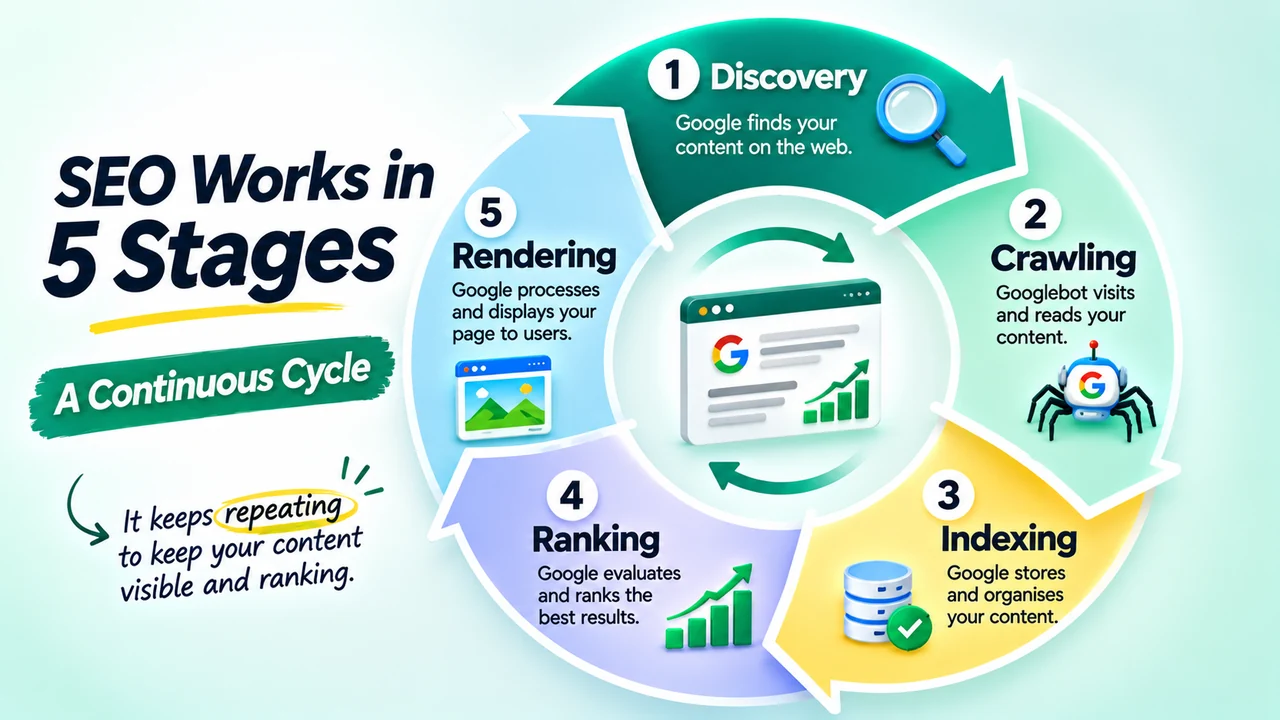
Every founder I meet has the same question in a different form: “I have a website, so why doesn’t Google send me customers?” The answer starts with scale. Google handles more than 5 trillion searches a year, roughly 14 billion a day, and sorts them against an index of hundreds of billions of web pages. Yet Ahrefs found that 96.55% of pages get no traffic from Google at all. Having a website is not the same as being found. SEO works by making your pages easy for search engines to find, understand and trust, so they show your business when people search for what you sell. Every page goes through a five-stage search engine cycle: discovery, crawling, rendering, indexing and ranking. A failure at any stage stops the page from reaching customers. In 2026-27, the same process also decides whether AI answers mention your brand.
TLDR
SEO, or search engine optimization, is the process of improving your website so search engines show it to people searching for your products or services. It works through a five-stage search engine cycle. In discovery, Google learns that a page exists through links, sitemaps and submissions. In crawling, Googlebot visits the page and downloads its code. In rendering, Google runs the page’s code, including JavaScript, to see it the way a visitor would. In indexing, Google analyses the content and decides whether to store it. In ranking, Google orders indexed pages for each search based on relevance, content quality and expertise, links and mentions, page experience and location. The cycle repeats as Google revisits pages. SEO also covers on-page content, authority, local SEO and now AI search visibility. Results usually take 3 to 12 months, and the business value comes from ranking for searches that lead to enquiries and sales, not from traffic alone.
What is SEO in simple terms?
SEO is the work of making your website the best answer to the searches your customers make, so Google shows it near the top without you paying for each click. Think of Google as a librarian for the internet. The librarian needs to know your book exists, understand what it is about, and trust that it is a good book before recommending it. SEO handles all three.
| Stage of the search engine cycle | The librarian analogy | What it means for your website |
|---|---|---|
| Discovery | The librarian hears that your book exists | Google learns your page’s URL |
| Crawling | The librarian fetches your book | Googlebot visits and downloads the page |
| Rendering | The librarian opens it and reads every page | Google runs the code to see the full content |
| Indexing | The librarian files it in the catalogue | Google understands and stores the page |
| Ranking | The librarian recommends it | Google shows the page for relevant searches |
In short: SEO is the work of making a website easy for search engines to find, understand and trust, so it appears high in unpaid search results when customers search for what the business offers.
What is the search engine cycle, and how does it work?
SEO works through five stages that I call the search engine cycle: discovery, crawling, rendering, indexing and ranking. Google’s own guide to how Search works groups this into crawling, indexing and serving, but splitting it into five stages makes it much easier for a founder to see exactly where a website can fail.
| Stage | What happens | What can go wrong | What SEO does |
|---|---|---|---|
| 1. Discovery | Google learns a URL exists | Orphan pages with no links, missing sitemap | Internal links, XML sitemaps, Search Console submission |
| 2. Crawling | Googlebot requests and downloads the page | Robots.txt blocks, server errors, slow responses | Clean robots.txt, stable hosting, fixed errors |
| 3. Rendering | Google runs the page’s code to see the final content | Content hidden behind JavaScript, blocked CSS or scripts | Server-side or pre-rendered content, accessible resources |
| 4. Indexing | Google analyses the page and decides whether to store it | Duplicates, wrong canonicals, noindex tags, thin content | Unique, helpful pages with correct canonical and index signals |
| 5. Ranking | Google orders indexed pages for each search | Weak relevance, low authority, poor experience | Intent-matched content, links, reviews, speed |
Stage 1: Discovery
Before Google can do anything with a page, it must know the URL exists. Google discovers pages by following links from pages it already knows, reading XML sitemaps, and processing URLs submitted in Search Console. A new service page that no other page links to and that is missing from your sitemap may never be discovered at all.
Stage 2: Crawling
Once a URL is discovered, Googlebot, Google’s automated crawler, visits it and downloads its code. Robots.txt rules can block crawling, and server errors or very slow responses can make Google crawl less often. Check that you are not blocking important sections with my free robots.txt checker.
Stage 3: Rendering
Many modern websites build their content with JavaScript. During rendering, Google runs the page’s code much like a browser does, so it can see the final text, links and images a visitor sees. If key content only appears after scripts run, or if scripts and stylesheets are blocked, Google may see an incomplete page. You can check the rendered version of any page with the URL Inspection tool in Search Console.
Stage 4: Indexing
Google analyses the rendered page’s text, images, structured data and signals such as the canonical URL, then decides whether to store it in its index, which holds hundreds of billions of pages and is well over 100 million gigabytes in size. Not every crawled page gets indexed. Duplicate, thin or low-value pages are often left out, which is why Search Console shows statuses such as “Crawled, currently not indexed”.
Stage 5: Ranking
When someone searches, Google looks through its index in a fraction of a second and orders the most relevant, useful results. It also adjusts results by factors such as location and language, which is why someone searching “CA near me” in Indiranagar sees different results from someone in Whitefield.
Why it is called a cycle
The process never stops. Google keeps rediscovering links, recrawling pages, re-rendering them after changes, updating the index and recalculating rankings. Every time you publish, update or fix a page, it goes through the cycle again, which is why SEO improvements take weeks to show and why ongoing maintenance matters.
In short: SEO works through a five-stage search engine cycle: discovery, where Google learns a URL exists; crawling, where Googlebot downloads the page; rendering, where Google runs the page’s code to see its full content; indexing, where Google analyses and stores useful pages; and ranking, where it orders indexed pages for each search. The cycle repeats continuously as pages change.
What decides which website ranks first?
Google uses hundreds of signals. For a founder, they group into seven practical factors.
| Ranking factor | What Google looks for | What you can do |
|---|---|---|
| Relevance and intent | Does the page match what the searcher wants? | Build pages that answer specific buying searches |
| Content quality and expertise | Is it helpful, accurate and written from experience? | Add real examples, data and author expertise |
| Authority | Do other trusted sites link to or mention you? | Earn links, PR, reviews and citations |
| Technical health | Can Google crawl and index the page easily? | Fix indexing, redirects and canonical issues |
| Page experience | Is it fast, mobile-friendly and secure? | Improve speed and mobile layout |
| Freshness | Is the information current? | Update key pages regularly |
| Location | Is the business near the searcher? | Optimise Google Business Profile and local pages |
Google’s guidance on helpful, people-first content explains how it assesses quality.
In short: Rankings depend on relevance to the search, content quality and expertise, authority from links and mentions, technical health, page experience, freshness and, for local searches, the business’s location.
What are the main types of SEO?
| Type of SEO | What it covers | Example task |
|---|---|---|
| Technical SEO | Crawling, indexing, speed, site structure | Fixing pages Google cannot index |
| On-page SEO | Content, titles, headings, internal links, schema | Rewriting a service page to match search intent |
| Off-page SEO | Backlinks, mentions, PR, reviews | Getting featured in an industry publication |
| Local SEO | Google Business Profile, maps, local citations | Getting reviews and ranking in the map pack |
| Content SEO | Guides, comparisons, FAQs that build topical authority | Publishing a pricing comparison page |
| AI search optimisation (GEO and AEO) | Visibility in AI Overviews, ChatGPT and Perplexity | Structuring answers so AI tools cite them |
You can check parts of your own setup with my free robots.txt checker, schema markup generator and SERP preview tool. For deeper on-page work, Road To Top 5 also offers a focused on-page SEO package.
In short: SEO includes technical SEO, on-page SEO, off-page SEO, local SEO, content SEO and, increasingly, AI search optimisation through GEO and AEO. Each type covers a different part of how search engines find, understand and trust a website.
How does SEO work for AI Overviews and ChatGPT?
AI search tools build answers from web content. Google’s AI Overviews draw on pages in Google’s index, and tools such as ChatGPT and Perplexity search the web and cite sources when they answer. So the same SEO foundations apply: your pages must be crawlable, clearly structured and trusted. Google’s guidance on AI features confirms that standard SEO best practices apply to appearing in them. What changes is the goal. On informational searches, Ahrefs found that the top result gets 58% fewer clicks when an AI Overview appears, so being cited inside the answer matters more. To see which related questions AI tools expand a search into, try the free query fan-out finder from Road To Top 5, and read my guide on how to rank in ChatGPT and Perplexity.
In short: AI Overviews and AI chatbots build answers from crawlable, trusted web pages, so the same SEO foundations apply. The difference is that being cited inside AI answers now matters as much as ranking, because AI Overviews reduce clicks on informational searches.
How long does SEO take to work?
SEO usually shows early movement in 3 to 6 months and meaningful business results in 6 to 12 months. New websites take longer. Ahrefs data shows only 1.74% of newly published pages reach the top 10 within a year, and 72.9% of top-10 pages are more than three years old.
| Time | What usually happens |
|---|---|
| Weeks 1 to 4 | Technical fixes, Google recrawls and reindexes pages |
| Months 1 to 3 | Long-tail and local searches start ranking |
| Months 3 to 6 | Commercial pages climb, first organic leads arrive |
| Months 6 to 12 | Rankings stabilise for competitive terms, leads grow |
| Year 2 onward | Authority compounds and cost per lead falls |
In short: SEO usually takes 3 to 6 months to show movement and 6 to 12 months to bring meaningful results. Only 1.74% of new pages reach the top 10 within a year, so patience and consistent work matter.
How does SEO turn into customers for a business?
Rankings only matter when they lead to revenue. SEO works for a business through a simple chain.
| Step | What happens | What to measure |
|---|---|---|
| Search | A customer searches for a problem or service | Impressions in Search Console |
| Click | They choose your result | Clicks and click-through rate |
| Landing page | They read your page | Engagement and time on page |
| Action | They call, fill a form or buy | Leads and sales in GA4 or your CRM |
| Return | They search your brand later | Branded search growth |
If the chain breaks at the landing page, more traffic will not help. That is why I always ask founders to measure leads, not just rankings.
In short: SEO brings customers through a chain of search, click, landing page, action and return visits. Each step should be measured, and leads and sales matter more than rankings or traffic alone.
How do you start making SEO work for your website?
Step 1: Connect Google Search Console
Verify your site, submit your sitemap and check which pages are indexed.
Step 2: List your money searches
Write down the 10 searches a ready-to-buy customer would make, such as “[service] in [city]” or “[product] price”.
Step 3: Build one strong page per search
Give each service, product or location its own page with a clear title, direct answers, proof and a call to action.
Step 4: Fix technical basics
Make sure important pages are indexed, load quickly on mobile and have no redirect or canonical errors.
Step 5: Build trust
Collect reviews, keep business details consistent online, and earn mentions from relevant sites.
Step 6: Measure and improve monthly
Track impressions, clicks and leads, then improve the pages closest to page one.
If you want to learn to do this yourself, my one-on-one SEO training is designed for founders, and local businesses can take the local SEO course.
In short: Start SEO by connecting Search Console, listing the searches buyers make, building one strong page per search, fixing technical basics, building trust through reviews and mentions, and measuring leads every month.
How can Road To Top 5 make SEO work for your business?
Understanding how SEO works is the first step. Making it work for a specific business takes focus, and that is what we do at Road To Top 5. We do not tie clients into long retainers. Instead, we run three-month SEO and GEO sprints built on our FPDP framework: we Find the high-impact opportunities in your market, Prioritise them by revenue impact, Discover new openings in Google and AI search, and Plan and execute the work that brings enquiries. Our SEO services cover technical, local, ecommerce, B2B and AI search, and our case studies show how this approach has worked for businesses like Nanak Accountants and Serenity Hostels. If you want SEO to start working for your website, contact the Road To Top 5 team.
In short: Road To Top 5 turns SEO knowledge into results through three-month SEO and GEO sprints based on the FPDP framework, focusing on the opportunities most likely to bring enquiries and sales, without long retainers.
Frequently asked questions
Is SEO free?
Organic rankings are free in the sense that you do not pay Google for each click, but SEO itself takes time, skills or budget. A founder who writes and optimises pages personally pays in hours; one who hires a specialist pays in fees. The return comes from leads that keep arriving without per-click costs once pages rank.
Does SEO work for small businesses?
Yes, SEO often works especially well for small businesses because local and niche searches face less competition than national ones. A physiotherapy clinic in Koramangala competes with a few dozen nearby clinics, not with national chains, so a strong Google Business Profile and a few well-built service pages can bring steady enquiries.
Can I pay Google to rank higher in organic results?
No, you cannot pay Google to rank higher in organic results. Paid ads appear in separate, labelled ad slots. Organic rankings are earned through relevance, quality and authority. Many businesses use ads for quick visibility while SEO builds long-term rankings.
How do I know if my SEO is working?
Check Google Search Console for rising impressions, clicks and average position on searches that matter to your business, and check GA4 or your CRM for leads from organic search. If impressions rise but leads do not, the problem usually sits on the landing page, not in the rankings.
Does social media affect SEO?
Social media does not directly raise Google rankings, but it helps indirectly. Social posts can get your content seen by people who later link to it, mention your brand or search for you by name. A founder whose LinkedIn post about an industry survey gets picked up by a trade publication earns a valuable link through social. To learn how to use all of this for your business, explore Mohit’s SEO Training.
Sources
- Search Engine Land: Google sees more than 5 trillion searches per year
- Google: How Search organises information
- Google Search Central: How Google Search works
- Google Search Central: Creating helpful, reliable, people-first content
- Google Search Central: AI features and your website
- Ahrefs: 96.55% of content gets no traffic from Google
- Ahrefs: SEO statistics
- Ahrefs: AI Overviews reduce clicks