
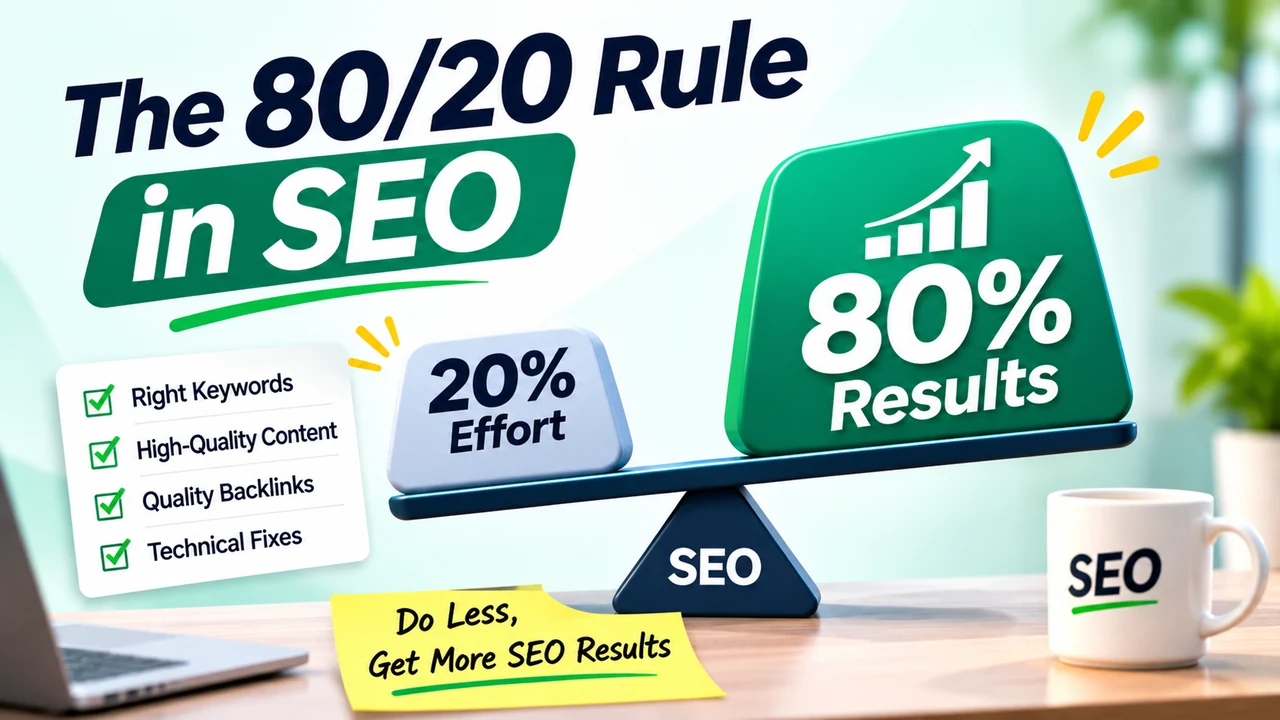
Founders rarely have an SEO problem. They have a focus problem. They publish blog after blog, buy backlink packages and chase every audit warning, and the traffic barely moves. The data shows why. Ahrefs found that 96.55% of all pages get zero traffic from Google, and Backlinko’s click-through research shows only 0.63% of users click results on page two. Effort spread thinly across many pages earns almost nothing. Effort concentrated on the right few pages earns almost everything. The 80/20 rule in SEO says that a small share of your pages, keywords, technical fixes and links produces most of your traffic, leads and revenue. For a founder with limited time and budget, the job is to find that 20% and put most of your SEO investment there.
TLDR
The 80/20 rule, or Pareto principle, applies strongly to SEO because search rewards a few winners: most pages get no traffic, page two gets almost no clicks, and most keywords have tiny search volume. For founders, the high-impact 20% usually means commercial pages that target buying-intent keywords, pages already ranking on positions 4 to 20, a handful of technical fixes that affect indexing, and a small number of strong links and brand mentions. You find your own 80/20 by sorting Search Console and GA4 data by clicks and conversions. Startups with no traffic should start with five to ten core commercial pages. In 2026-27, the rule also applies to AI search: a few strong pages and brand mentions earn most AI citations.
What is the 80/20 rule in SEO?
The 80/20 rule, known as the Pareto principle, says that roughly 80% of outcomes come from roughly 20% of causes. In SEO it means a small part of your website and your SEO activity drives most of your results. The ratio is rarely exactly 80/20. On some websites 10% of pages bring 90% of traffic. The principle matters more than the exact numbers: results are concentrated, so effort should be too.
| SEO area | The “20%” | The “80%” it drives |
|---|---|---|
| Pages | A few service, product or category pages | Most organic leads and sales |
| Keywords | A small set of buying-intent searches | Most conversions |
| Technical SEO | A handful of indexing and crawl fixes | Most of the visibility gains |
| Links | A few links from trusted, relevant sites | Most of the authority benefit |
| Content | A few cornerstone guides | Most backlinks and AI citations |
In short: The 80/20 rule in SEO means a small share of pages, keywords, technical fixes, links and content drives most of a website’s traffic, leads and revenue. The exact ratio varies, but results are always concentrated.
Why does the 80/20 rule apply so strongly to SEO?
Search is a winner-takes-most system. The data from large studies shows how concentrated the rewards are.
| Data point | What it shows | Source |
|---|---|---|
| 96.55% of pages get zero Google traffic | Most published pages produce nothing | Ahrefs |
| 94.74% of keywords get 10 or fewer monthly searches | A small set of keywords carries most demand | Ahrefs |
| 0.0008% of keywords get over 100,000 monthly searches | Big demand sits in very few terms | Ahrefs |
| Only 0.63% of users click page-two results | Page one takes almost all clicks | Backlinko via Search Atlas |
| Strategic SEO returns 748% ROI, basic blogging 16% | The type of work matters more than the volume | First Page Sage via Resourcera |
For a founder, this means volume is a weak strategy. Ten pages that rank on page one for buying-intent searches are worth more than a hundred pages that never leave page three.
In short: The 80/20 rule fits SEO because most pages get no traffic, most keywords have tiny demand, page two gets only 0.63% of clicks, and strategic SEO returns far more than high-volume basic content.
Which 20% of SEO work brings 80% of results for founders?
After years of auditing websites for startups and small businesses, I see the same high-impact areas again and again.
Commercial pages that target buying intent
Service pages, product and category pages, pricing, comparisons and “alternatives” pages convert far better than general blogs. Build and improve these first.
Pages already ranking on positions 4 to 20
These “striking distance” pages already have Google’s attention. Better titles, deeper content, internal links and a few links can move them onto the first page faster than any new page.
Technical fixes that affect indexing
If Google cannot crawl or index a page, nothing else matters. A few fixes to robots.txt, canonical tags, redirects and internal links often unlock more growth than months of content.
A few strong links and brand mentions
One feature on a respected industry site, a founder interview or a mention in a trusted comparison list often outweighs dozens of low-quality links.
One or two cornerstone guides
A genuinely useful guide, tool or piece of original data earns links, AI citations and trust that support every commercial page.
In short: For most founders, the high-impact 20% of SEO is commercial pages with buying intent, pages ranking on positions 4 to 20, indexing-related technical fixes, a few strong links and mentions, and one or two cornerstone guides.
How do you find your own 80/20 in Google Search Console?
Your website has its own 80/20, and your data shows it. Use these steps.
Step 1: Find the pages that bring most clicks
In Google Search Console, open Performance, select the last 12 months, open the Pages tab and export it. Sort by clicks and add a running total. You will usually find that a small group of pages brings the majority of clicks.
Step 2: Find the pages that bring revenue
In GA4, open the landing page report filtered to organic search and sort by conversions or revenue. The pages that drive leads are not always the ones that drive traffic.
Step 3: Find your striking-distance keywords
In Search Console, filter queries with an average position between 4 and 20 and high impressions. Match each to its page. These are your fastest wins.
Step 4: Find what is blocking growth
Open the Pages indexing report and list important URLs marked “Crawled, currently not indexed”, “Discovered, currently not indexed” or excluded by noindex or canonical. Fix the ones that matter to the business first. This find-then-prioritise sequence is also the first half of the FPDP framework we use at [Road To Top 5](https://roadtotop5.com/), where every opportunity is ranked by revenue impact before any work begins.
Step 5: Build a priority list
| Priority | What goes here |
|---|---|
| 1 | Revenue pages with indexing or technical problems |
| 2 | Commercial pages on positions 4 to 20 |
| 3 | Top traffic pages with weak conversion |
| 4 | Missing commercial pages competitors rank for |
| 5 | Everything else |
In short: Find your SEO 80/20 by exporting Search Console pages and sorting by clicks, checking GA4 for pages that drive conversions, finding queries on positions 4 to 20, listing indexing problems on important pages, and ranking all of it into one priority list.
What is the 80/20 rule for a startup with no traffic yet?
A new website has no Search Console history, so you build your 20% from market data instead.
| Step | What to do |
|---|---|
| 1 | List the 5 to 10 searches a ready-to-buy customer would make |
| 2 | Check which of those searches competitors rank for and what format ranks |
| 3 | Build one strong page for each: services, pricing, comparisons, use cases or locations |
| 4 | Fix technical basics before launch: indexing, speed, mobile, schema |
| 5 | Earn a few relevant links and listings from your network and industry |
| 6 | Use small Google Ads tests to learn which keywords convert, then target those with SEO |
Local businesses should add Google Business Profile optimisation and reviews to this list, because local pack visibility often brings calls before website rankings do. My local SEO course covers this in detail.
To compare your keyword coverage with competitors quickly, try the free SEO gap checker from Road To Top 5, and use the query fan-out finder to see the related questions AI search expands your main keywords into.
In short: A startup with no traffic should build its SEO 80/20 from market data: identify 5 to 10 buying-intent searches, build one strong page for each, fix technical basics, earn a few relevant links and use small ad tests to confirm which keywords convert.
Which technical SEO fixes deliver 80% of the impact?
Technical audits often list hundreds of warnings. Most do not matter much. These do.
| Fix | Why it matters | How common the problem is |
|---|---|---|
| Indexing of important pages | Unindexed pages cannot rank | Very common on new and large sites |
| Redirect issues | Chains and broken redirects waste crawling and dilute signals | 95.2% of sites have 3XX redirect issues |
| Page speed and Core Web Vitals | Slow pages hurt rankings and conversions | Only 33% of websites pass Core Web Vitals |
| Hreflang for multi-country sites | Wrong country versions rank | Over 67% of domains using hreflang have issues |
| Internal links to money pages | Tells Google which pages matter most | Often ignored |
| Robots.txt and canonical errors | Can hide whole sections from Google | Common after redesigns and migrations |
Check your robots.txt with my free robots.txt checker, and use the hreflang tag generator if you serve several countries.
Platform matters too, because each CMS creates its own technical problems. Road To Top 5 handles platform-specific fixes through its WordPress SEO, Shopify SEO and Wix SEO services.
In short: The technical SEO fixes that deliver most impact are indexing important pages, cleaning redirects, improving speed, correcting hreflang, strengthening internal links to money pages and removing robots.txt and canonical errors. Most other audit warnings matter far less.
What 80/20 mistakes do founders make in SEO?
| Mistake | Why it wastes budget | Better 80/20 choice |
|---|---|---|
| Publishing many generic blogs | Basic content returns about 16% ROI | Build commercial pages first |
| Fixing every audit warning | Most warnings have little impact | Fix indexing and crawl issues first |
| Buying backlink packages | Low-quality links add little authority | Earn a few relevant links and mentions |
| Chasing high-volume keywords | Huge competition, low conversion | Target specific buying-intent searches |
| Ignoring pages on positions 4 to 20 | Misses the fastest wins | Improve striking-distance pages first |
| Measuring traffic instead of leads | Rewards the wrong pages | Track conversions by landing page |
In short: Founders waste SEO budget by publishing generic blogs, fixing every audit warning, buying backlink packages, chasing high-volume keywords, ignoring striking-distance pages and measuring traffic instead of leads.
How does the 80/20 rule apply to AI search in 2026-27?
AI search makes the 80/20 rule even sharper. Ahrefs found that the top result gets 58% fewer clicks when an AI Overview appears, mostly on informational queries. That pushes more of the value into commercial searches, where users still click to compare and buy. AI tools also cite a limited number of sources per answer, so a few strong, well-structured pages with clear answers, original data and strong brand mentions earn most of the AI visibility. For founders, the 2026-27 version of the 80/20 rule is simple: invest in a small set of excellent commercial pages and cornerstone resources, and build brand mentions on trusted sites. I explain the AI side in my guide on how to rank in ChatGPT and Perplexity.
In short: In 2026-27, AI Overviews reduce clicks on informational searches and AI tools cite only a few sources, so the 80/20 rule favours a small set of strong commercial pages, cornerstone resources and brand mentions on trusted sites.
How often should you revisit your SEO 80/20?
Revisit your 80/20 every quarter. Rankings shift, new competitors appear, AI search changes click patterns, and your own product and pricing evolve. A quarterly review of Search Console, GA4 and your priority list keeps your effort on the pages that matter now. If you want to build this review skill yourself, my one-on-one SEO training is designed for founders, and my advanced online SEO training suits founders who want to train a team member.
In short: Review your SEO 80/20 every quarter using Search Console and GA4, because rankings, competitors, AI search behaviour and your own offer change over time.
How can Road To Top 5 apply the 80/20 rule to your website?
The 80/20 rule sits at the heart of how we work at Road To Top 5. Our FPDP framework was built for founders who cannot afford to spread SEO budget thinly: we Find the high-impact opportunities in your Search Console data and your market, Prioritise them by revenue impact, Discover new openings in Google and AI search, and Plan and execute only the work that moves leads and sales. We do not lock clients into retainers. Instead, we run three-month SEO and GEO sprints, so you see the impact of your most important 20% quickly and decide what comes next based on results. If your team is busy and you want someone to find and fix your high-impact 20%, book a conversation with Road To Top 5.
Founders on smaller budgets can start with a focused SEO strategy package, and you can read real results from businesses like Nanak Accountants and One Box Office in our case studies.
In short: Road To Top 5 applies the 80/20 rule through its FPDP framework and three-month SEO and GEO sprints, finding the opportunities that matter most, prioritising them by revenue impact and executing only the high-impact work, without long retainers.
Frequently asked questions
Is the 80/20 rule exact in SEO?
No, the 80/20 rule is a pattern, not a fixed ratio. On one website 15% of pages may bring 85% of clicks; on another, 5% may bring 95%. The useful point is that results are concentrated, so a founder should always look for the small group of pages and actions that drive most outcomes.
Should I delete pages that get no traffic?
Not automatically. First check whether a page has backlinks, conversions, a business purpose or ranking potential. Improve pages that target useful searches, merge thin pages that cover the same topic, and remove or redirect only those with no value. A clinic’s old “Diwali offer 2021” page can go; a service page with no traffic yet may just need better content and links.
How many pages does a small business website need for SEO?
Most small businesses need fewer pages than they think: one strong page per core service or product, location pages if they serve several areas, an about page, a contact page, and a few genuinely helpful guides. A CA firm with four services and two locations may do well with fifteen excellent pages rather than a hundred thin blog posts.
Does the 80/20 rule apply to backlinks?
Yes, a small number of strong, relevant links usually provides most of the authority benefit. One link from a respected industry publication or a well-known partner often outweighs many links from random directories. Focus outreach on a short list of sites your customers actually read.
What is the 80/20 rule in content marketing?
A common version says to spend about 20% of your effort creating content and 80% distributing and promoting it. For SEO, it also means a few cornerstone pieces will earn most of your links, shares and AI citations. One original industry survey can outperform a year of generic weekly posts.
Sources
- Ahrefs: 96.55% of content gets no traffic from Google
- Ahrefs: SEO statistics (keywords, redirects, Core Web Vitals, hreflang)
- Ahrefs: SEO statistics (keyword distribution)
- Search Atlas: SEO statistics (Backlinko page-two clicks)
- Resourcera: SEO ROI statistics (First Page Sage data)
- Ahrefs: AI Overviews reduce clicks